Cartier Métiers d’Art Watch Collection 2013 part 3: Engraving and Champlevé Enamel

Cartier Métiers d’Art Watch Collection 2013 part 3: Engraving and Champlevé Enamel

Since Cartier decided to set up the Haute Horlogerie division, they have tried new techniques in both future technology and ancient skills to explore the possibilities of craftsmanship. On one hand, they are pushing the frontiers of mechanical engineering and on the other hand, they are reviving forgotten decorative arts like plique-à-jour enamelling, grisaille enamelling, straw marquetry, granulation and cameo.
In this third report of the techniques found in the Métiers d’Art Watch Collection, we will be looking at one of the grand feu enamelling techniques used to make watch dials used by Cartier in 2013.

Olivier Ziegler © Cartier 2009
Champlevé enamel
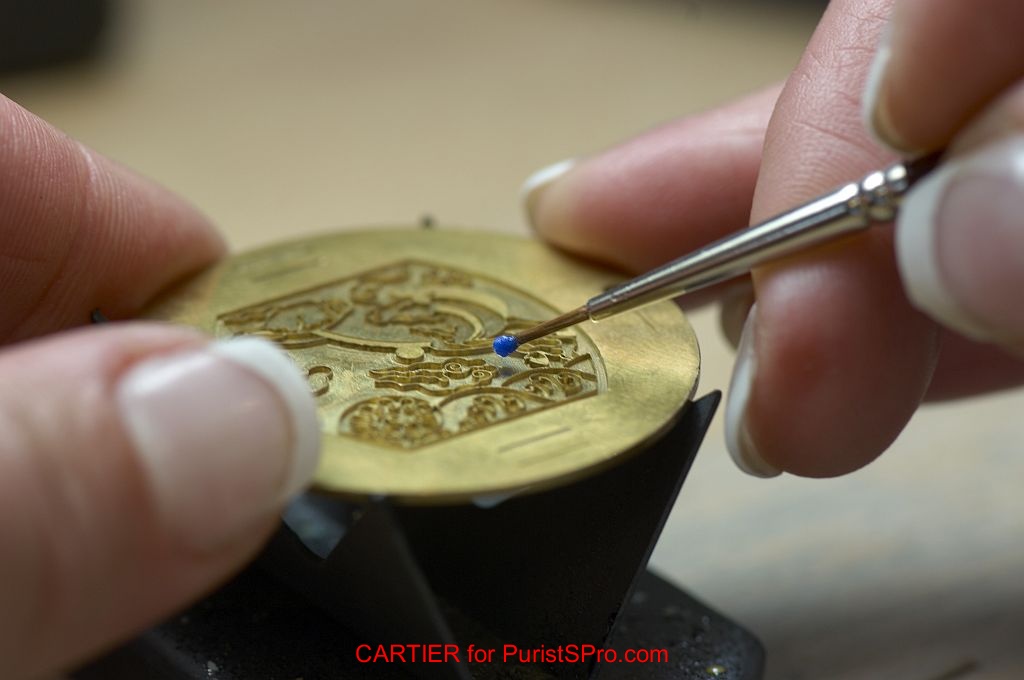
Champlevé is French for "raised field", where the surface is carved out to form pits or recesses. Enamel is wet-packed into the carved areas and 'fired' leaving areas with exposed metal and area with raised enamel.
By far the oldest technique, champlevé enamelling requires an engraved motif in a metal die mould before filling the cavities thus formed with enamel. Using a drypoint (graving tool), the engraver traces the desired pattern on the watch case or dial. Being careful to avoid the contours, he hollows out the various fields, thereby achieving a relief engraving featuring grooves of various width and thickness according to the desired effects, with rims as clear-cut as possible.

The enamels are then applied to the crevices before being melted at over 800°C. Such a creation calls for several firings, followed by a lapping (polish) process to smooth over the surfaces of the work and a glazing firing to give it its final appearance.

Close cooperation and genuine creative synergy between the engraver and the enameller are required, since the final result will depend on both skills, especially when using translucent enamels that enable viewing all the details of the engraving through a transparent coating.

Vincent Wulveryck © Cartier 2013
Santos-Dumont watch, XL size, falcon motif with high relief hand engraving and champlevé enamel
Case: rhodium-coated 18K white gold (OPTION set with 49 baguette-cut diamonds totalling 6.31 carats)
Crown: octagonal crown set with a sapphire (OPTION set with brilliant-cut diamond of 0.34 carats)
Dial: 18K white gold falcon motif, hand-engraved in high relief and champlevé enamel
Strap: semi-matt black alligator skin
Clasp: double adjustable folding clasp in 18K white gold (OPTION set with 37 baguette-cut diamonds totalling 0.85 carats)
Water-resistance: 30 metres / 100 ft / 3 bar
Manufacture mechanical movement with manual winding, calibre 430 MC
Numbered limited edition of 20 pieces
Background on enamel techniques
Enamel first appeared around the Mediterranean Sea in ancient times as did the forming of crystal glass. It was used in jewellery and other body adornments before spreading to Europe. Watchmakers adopted the technique much later than jewellers, probably in the 15th century. Essentially, all vitreous (porcelain) enamels are melted fusion of powdered glass with colouring mineral oxides on metal substrates.
Compared with “classic” enamels, the distinctive nature of “grand feu” enamels is because they reach their melting point at a far higher temperature (820°C – 850°C). This technique makes them extremely pure and guarantees the longevity of the resulting products.
Raw enamel comes in lumps or as coarse powder. During the preparation process, the material is ground in a mortar to create an extremely fine powder, which is then thoroughly rinsed. The cleaned and ready-to-use enamels are stored in distilled water.
Enamel is always placed on a metal die mould and only copper, silver and gold have the qualities required for this purpose.
Cartier always uses precious 18K white gold as the ‘base’ metal for their enamel dials.
Cartier Métiers d’Art Series
Cartier Métiers d’Art part 1 - Grisaille Enamel: CLICK the following URL link:
cartier.watchprosite.com
Cartier Métiers d’Art part 2 - Miniature Painting and Plique-à-jour Enamel: CLICK the following URL link:
cartier.watchprosite.com
Cartier Métiers d’Art part 3 - Engraving and Champlevé Enamel:CLICK the following URL link:
cartier.watchprosite.com
Cartier Métiers d’Art part 4 - Gold Granulation: CLICK the following URL link:
cartier.watchprosite.com
Cartier Métiers d’Art part 5 - Agate Cameo Carving: CLICK the following URL link:
cartier.watchprosite.com
Dr M. Teillol-Foo (2013) PuristSPro
This message has been edited by MTF on 2013-09-10 12:29:53


Next Article

Cartier Métiers d’Art Watch Collection 2013 part 2: Plique-à-jour Enamel
© 2017 - WatchProZine