
The classic beauty of the Girard-Perregaux 1966 Chronograph
foversta

I would like to share my thoughts with you about one of my fav chronographs: the Girard-Perregaux 1966 Chronograph.
Step by step, from 2006, Girard-Perregaux has been adding new complications in the 1966 line which becomes now maybe the keystone of the collection. The name of this line is a tribute to the Centenary Prize received by the brand and given by the Neuchâtel Observatory to reward the work on precision and high-frequency calibers. Despite the origin of this name, the objective of this line is more to offer a range of elegant and thin watches which gives the proof of the skills of the Manufacture on the field of timeless timepieces. From my point of view, it is a bit strange to use a reference of a milestone year which symbolizes the quest of precision, the innovation, the high-frequency calibers (and soon the quartz ones) for a whole line dedicated to classicism. Anyway, it is not a big issue.
Without any doubt, the afficionados of the brand were expecting a chronograph in this line with a lot of hope and maybe a bit of anxiety. The hope was coming from the flawless designs of the previous 1966 watches: very thin cases with short and curved lugs, an elegant bezel, balanced dials. The context of a 1966 watch was very positive. On the other hand, due to the classic architecture of a chronograph caliber, maybe an 1966 Chronograph would have been a bit too thick to be really faithfull to the line.
And when the two 1966 Chronographs were unveiled at the 2011 SIHH (white gold and pink gold cases), it was a relief: Girard-Perregaux managed to add this very complex complication (I still believe that the chronograph is one of the most difficult complications to be handled) without losing what makes the 1966 line so special: its elegancy. On the other side, Girard-Perraux had to accept some constraints to achieve this result.

The case of the 1966 Chronograph has a 40mm diameter like the other complicated watches of the line, the Full Calendar and the Annual Calendar & EOT. I really like its inclined bezel and the shape of the lugs which contributes a lot to the comfort on the wrist. The thickness of the case is 12,05mm, only 1,3mm more than the other two complicated watches. Good point. The ratio diameter/thickness is still quite high which is the proof that the slenderness has been preserved. The pushers are well integrated into the overall design and they are quite nice at the use.
One of the most impressive parts of the watch is the dial. Girard-Perregaux managed to put a lot of information on it, including a tachometric scale without losing its balance. The contrast between the three blued hands and the dial brings a bit of fantasy because Girard-Perregaux decided to do it very soberly... what is a good idea in this context. The main hands are made of the same material than the indexes, the applied numbers and the case: there is a feeling of harmony which emanates from this dial. Due to the use of the same material, the Pink Gold version had maybe a warmer atmosphere than the White Gold one which is the quieter... by far. The applied indexes and figures add a welcome volume on the dial. It is a slight criticism which can be made to the 1966 line: sometimes the dials are a bit too "flat". That's not the case with the chronograph, Girard-Perregaux found the magic formula with a perfect combo between the printed sections and the applied parts. Maybe some would have prefered that the permanent second hand has a similar colour than the one of the two main hands (a bit "à la Duomètre" to make a clear difference between the time and chronograph displays): I prefer here the classic solution used by Girard-Perregaux.

The tachometric scale has actually an important role for this watch, much more important than the pure additional function. Its main role is to hide the fact that the caliber used is too small for the case. The logical consequence is that the two subdials are too close to the center of the watch. Hopefully, the designers worked with efficiency on this topic: thanks to the presence of the scale, the two subdials have a sufficient size and, moreover, their positions are not shocking.
Time comes to have a look at the caseback. And, of course, we find the reason why of the dial lay-out. the caliber is a bit lost in the case. The GP030C0, an automatic caliber with a 4hz frequency has a 23,70mm diameter which is too short for a 40mm case. Question is: why Girard-Perregaux didn't choose to use a 38mm case for example? I think that this solution wouldn't have been possible. With 38mm, the problem remains the same and maybe they wouldn't have enough space to insert the scale. With such size of movement, I think that a 36mm case is perfect. But this is not acceptable in terms of expectations from the clients. And they can't release a chronograph smaller than the 3 hands watch...

The caliber is very nicely made but it is a bit frustrating: due to its architecture, the chronograph parts are located dial side. Girard-Perregaux built this movement in order to be as smaller as possible. Its thickness is 6,28mm which is a good result and its power reserve is 36 hours which is quite low. But a least, the Lange chrongraphs owners won't be lost with such poser reserve. So what Girard-Perregaux gains in terms of efficiency (thickness, column-wheel, 4hz), they lose it in terms of aesthetic: the caliber looks like a three-hands caliber. At the end, I think that I would have prefered a solid caseback. The finishings of the caliber are in the standards of Girard-Perregaux: not eyes-catching but flawless.

On the wrist, thanks to its slender case and the shape of the lugs, the watch is very comfortable. And it is when you wear it than you are trully seduced by its elegancy and its timeless design. Don't expect a love at first sight but the 1966 Chronograph will seduce you more and more, day after day. It is the kind of watches with which there is only a very low probability to be tired of.


Despite some drawbacks, the 1966 Chronograph is a very valuable offer from Girard-Perregaux in the world of "bicompax" chronographs with Manufacture movements. The specificity of this watch is the use of an automatic movement, very rarely seen in this context. The GP030C0 is not the most beautiful caliber in the world but it is efficient and coherent with the spirit of the watch. And to the people who hesitate to take the plunge in front of this watch, my only advice is to admire the beauty of the dial... it will convince them!
Fx
This message has been edited by AnthonyTsai on 2011-07-11 17:11:44
Step by step, from 2006, Girard-Perregaux has been adding new complications in the 1966 line which becomes now maybe the keystone of the collection. The name of this line is a tribute to the Centenary Prize received by the brand and given by the Neuchâtel Observatory to reward the work on precision and high-frequency calibers. Despite the origin of this name, the objective of this line is more to offer a range of elegant and thin watches which gives the proof of the skills of the Manufacture on the field of timeless timepieces. From my point of view, it is a bit strange to use a reference of a milestone year which symbolizes the quest of precision, the innovation, the high-frequency calibers (and soon the quartz ones) for a whole line dedicated to classicism. Anyway, it is not a big issue.
Without any doubt, the afficionados of the brand were expecting a chronograph in this line with a lot of hope and maybe a bit of anxiety. The hope was coming from the flawless designs of the previous 1966 watches: very thin cases with short and curved lugs, an elegant bezel, balanced dials. The context of a 1966 watch was very positive. On the other hand, due to the classic architecture of a chronograph caliber, maybe an 1966 Chronograph would have been a bit too thick to be really faithfull to the line.
And when the two 1966 Chronographs were unveiled at the 2011 SIHH (white gold and pink gold cases), it was a relief: Girard-Perregaux managed to add this very complex complication (I still believe that the chronograph is one of the most difficult complications to be handled) without losing what makes the 1966 line so special: its elegancy. On the other side, Girard-Perraux had to accept some constraints to achieve this result.
The case of the 1966 Chronograph has a 40mm diameter like the other complicated watches of the line, the Full Calendar and the Annual Calendar & EOT. I really like its inclined bezel and the shape of the lugs which contributes a lot to the comfort on the wrist. The thickness of the case is 12,05mm, only 1,3mm more than the other two complicated watches. Good point. The ratio diameter/thickness is still quite high which is the proof that the slenderness has been preserved. The pushers are well integrated into the overall design and they are quite nice at the use.
One of the most impressive parts of the watch is the dial. Girard-Perregaux managed to put a lot of information on it, including a tachometric scale without losing its balance. The contrast between the three blued hands and the dial brings a bit of fantasy because Girard-Perregaux decided to do it very soberly... what is a good idea in this context. The main hands are made of the same material than the indexes, the applied numbers and the case: there is a feeling of harmony which emanates from this dial. Due to the use of the same material, the Pink Gold version had maybe a warmer atmosphere than the White Gold one which is the quieter... by far. The applied indexes and figures add a welcome volume on the dial. It is a slight criticism which can be made to the 1966 line: sometimes the dials are a bit too "flat". That's not the case with the chronograph, Girard-Perregaux found the magic formula with a perfect combo between the printed sections and the applied parts. Maybe some would have prefered that the permanent second hand has a similar colour than the one of the two main hands (a bit "à la Duomètre" to make a clear difference between the time and chronograph displays): I prefer here the classic solution used by Girard-Perregaux.
The tachometric scale has actually an important role for this watch, much more important than the pure additional function. Its main role is to hide the fact that the caliber used is too small for the case. The logical consequence is that the two subdials are too close to the center of the watch. Hopefully, the designers worked with efficiency on this topic: thanks to the presence of the scale, the two subdials have a sufficient size and, moreover, their positions are not shocking.
Time comes to have a look at the caseback. And, of course, we find the reason why of the dial lay-out. the caliber is a bit lost in the case. The GP030C0, an automatic caliber with a 4hz frequency has a 23,70mm diameter which is too short for a 40mm case. Question is: why Girard-Perregaux didn't choose to use a 38mm case for example? I think that this solution wouldn't have been possible. With 38mm, the problem remains the same and maybe they wouldn't have enough space to insert the scale. With such size of movement, I think that a 36mm case is perfect. But this is not acceptable in terms of expectations from the clients. And they can't release a chronograph smaller than the 3 hands watch...
The caliber is very nicely made but it is a bit frustrating: due to its architecture, the chronograph parts are located dial side. Girard-Perregaux built this movement in order to be as smaller as possible. Its thickness is 6,28mm which is a good result and its power reserve is 36 hours which is quite low. But a least, the Lange chrongraphs owners won't be lost with such poser reserve. So what Girard-Perregaux gains in terms of efficiency (thickness, column-wheel, 4hz), they lose it in terms of aesthetic: the caliber looks like a three-hands caliber. At the end, I think that I would have prefered a solid caseback. The finishings of the caliber are in the standards of Girard-Perregaux: not eyes-catching but flawless.
On the wrist, thanks to its slender case and the shape of the lugs, the watch is very comfortable. And it is when you wear it than you are trully seduced by its elegancy and its timeless design. Don't expect a love at first sight but the 1966 Chronograph will seduce you more and more, day after day. It is the kind of watches with which there is only a very low probability to be tired of.
Despite some drawbacks, the 1966 Chronograph is a very valuable offer from Girard-Perregaux in the world of "bicompax" chronographs with Manufacture movements. The specificity of this watch is the use of an automatic movement, very rarely seen in this context. The GP030C0 is not the most beautiful caliber in the world but it is efficient and coherent with the spirit of the watch. And to the people who hesitate to take the plunge in front of this watch, my only advice is to admire the beauty of the dial... it will convince them!
Fx
This message has been edited by AnthonyTsai on 2011-07-11 17:11:44
Comments:

amanico July 9th, 2011-15:02
I have to agree with you. A superb Chrono which would deserves a bigger movement OR even better, a manual wind one, or, CHERRY On The Black Forest, a rattrapante manual Chrono. The dial and the case are to die for. I personally fell in love with the blue dial. One of the many nice...

foversta July 9th, 2011-15:25
Sure... with a HW movement, the watch would become irresistible. I would like to see again the Blue dial version, I only saw it in the windows of the SIHH. Thanks for your input Nico. Fx


Mostel July 9th, 2011-16:41
Obviously a beautiful watch But it is 'sad' in a way that so many disclaimers must come with a 'review' of this watch. If one has to mention all the 'drawbacks' and the 'compromises', one feels sort of that GP 'should have' left their comfort zone and made the 'right' design... It s...
playtime July 9th, 2011-18:38
an even handed appraisal... thx for your observations--I was wondering how you would view the size of the movement given the diameter of the case. Your explanation seems reasonable. Whatever the case, it is a gorgeous watch, and a wonderful addition to the 1966 line--though i ultimt...

alex July 10th, 2011-01:36
many valid points FX but for me the major drawback is the modular construction of the chronograph, I would have prefered an integrated one.
amanico July 10th, 2011-01:42
Totally agree, Alex. Would have much preferred a solution of this kind, too. That is the main problem of the Vintage 66 line, and most particularly of the Chrono. I would have taken the option of a solid case back, since it is a modular construction. Best, my friend. Nicolas.
foversta July 10th, 2011-03:48
I was not clear in my writing... But the modular construction is also underlined in the article when I spoke about the chronograph parts dial side and the view on the base caliber. I should have been clearer about this. BTW, for a modular chronograph, the crown and pushers are quite well...
Mostel July 10th, 2011-07:17
Is it not odd that the AP ROO has the same drawbacks etc yet virtually no one ever talks about them (modular construction, movement 'lost' in the case). I was thinking about this last night... I guess it is because the AP ROO is a sport-watch, but also because the layout of the dial does not 'betray' the too-sm...
alex July 10th, 2011-07:35
I wouldn't buy a ROO for the same reason. I don't really care if the movement is too small or big for the case, but I wouldn't buy any high end chronograph with a modular construction
0-10-10
Load More Comments
Next Article
MTF

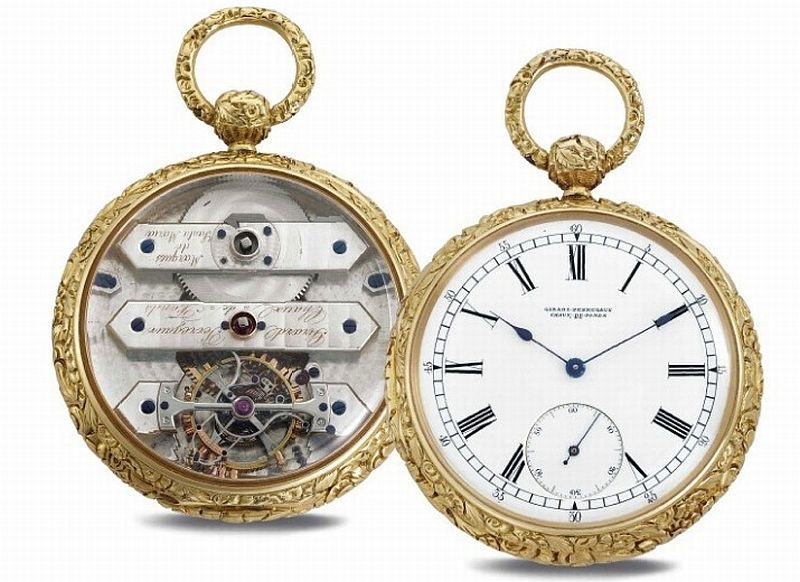
Rare Girard-Perregaux 3-Bridges Tourbillon Pocket Watch
MTF
Dear forumners, First, I must declare no financial interest in the watch below. The background chatter amongst PuristS collectors has reached sufficient level that I am compelled to bring your attention to a rare Girard-Perregaux Three-Bridge tourbillon for auction at Christies on 15 June in New York City. You can read all the academic text reproduce with permission from Christies but the real interesting points are summarised by a Girard-Perregaux expert who remains anonymous: "It is rather rare to have a 3-bridges tourbillon fitted in an open-face pocket watch in the 1880s. This one also has the pecularity of mixing two bridge shapes (straight and arrow-shape) on the same movement.
© 2017 - WatchProZine