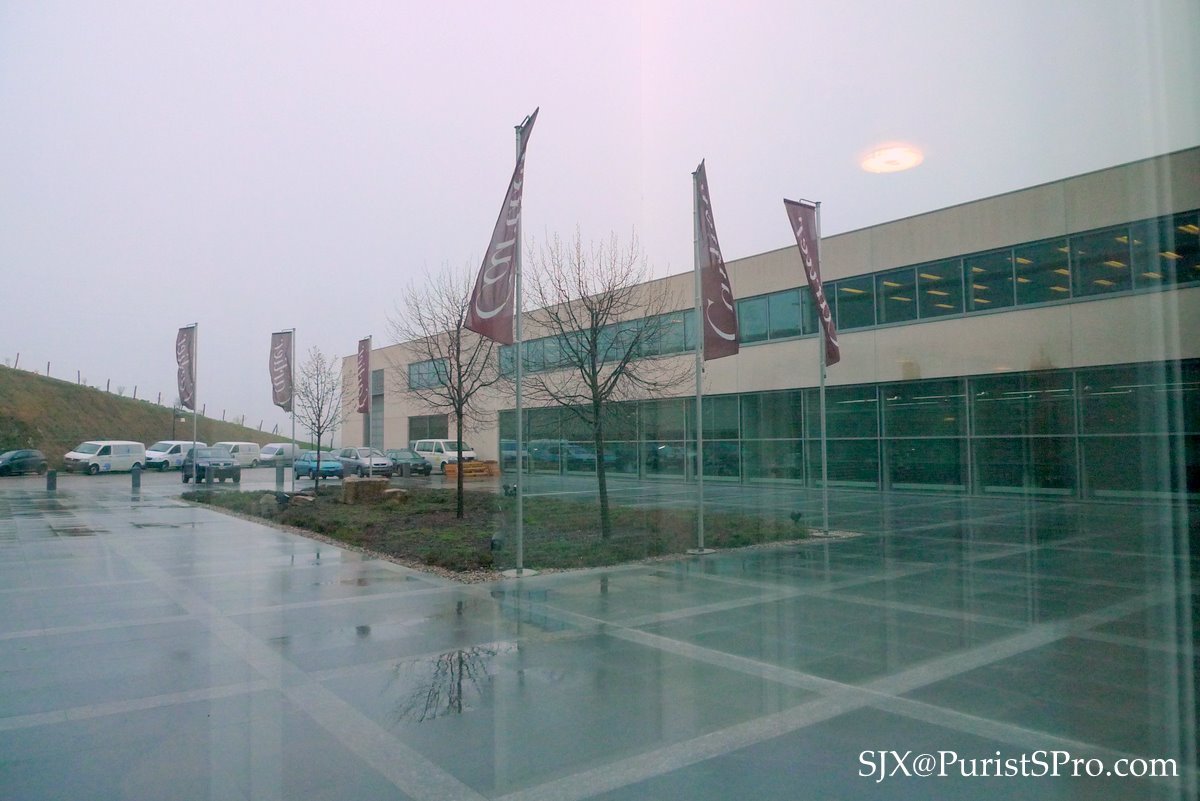
Live from La Chaux-de-Fonds – the Cartier manufacture

This is a brief report about my first day at the Cartier manufacture, live from a chilly La Chaux-de-Fonds. Located in La Chaux-de-Fonds, the Cartier manufacture is expansive and extremely capable. Literally an entire watch, save for sapphire crystals, can be made here. Typically components used are a mixture of outsourced and in-house production. For instance two thirds of hands come from Universo and Aiguilla while one third is made at La Chaux-de-Fonds.
Update: click here for an in-depth, 13-part report on the Cartier manufacture.

Beginning with where nearly all Cartier's technical geniuses reside, a department known as the Think Tank (yes, there is a pun on Tank). Headed by Carole Forestier, this occupies a floor on one wing. The Think Tank creates concepts from proposals put forward by the marketing team like: "We can a skeleton that is different from the rest."

A page from Carole’s notebook dated 2007 with the first sketch of the Santos skeleton movement
The concept from the Think Tank is then sent a committee for approval. Once a watch design is approved, several steps follow, one of which is the creation of plastic models printed by a three-dimensional printer.

Pierre Piffeteau, Customer Service Manager, with the 3D printer

Samples of plastic models
A fully fledged prototyping department, which has CNC milling and stamping machines and everything else, exists to create prototypes of watches.


Watch movements are also made in La Chaux-de-Fonds naturally in the movement component fabrication department.

A sample of components made at the manufacture, the baseplate for the Santos 100 skeleton is obvious
But beyond the production of parts for current movements, components for vintage Cartier watches are also produced for restoration work. Cartier can and will remake any part for a vintage Cartier timepiece – this is a remarkable commitment to customer service. At the time of my visit a balance wheel was being milled.

The screwed balance wheel being made for a restoration
Another enormous room at the manufacture contains 18 CNC machines dedicated to making bracelets and clasps. Besides the immense, dangerous looking machinery the smell of oil and slick floor is evidence that serious work is taking place.

These bracelet and clasp components are made by machine, but then finished by hand in several steps. The first step is shown below to remove the rough edges. Finer polishing is done later. The same applies for cases, machines first and then careful hand finishing.

Smoothing a raw component destined for the Santos 100 clasp
Cartier makes a third of its hands in-house. Stamping, polishing, bluing and application of Luminova are all done in a modest sized room. Below is a shot of the initial polishing of the raw hands after they are punched from a sheet of steel.

Mineral crystals are also made in-house. Most interesting is a gentleman who shapes the cut crystal by hand over a flame; the process heats the crystal so that it’s soft enough to be moulded into the required shape. The tortue perpetual calendar uses a curved mineral crystal for example.

One of the many steps in quality control at the manufacture is the use of high-speed cameras to record the motion of chronograph hands. These take several hundred frames per second and record the flexing of the chronograph hand as it resets.

An Olympus high-speed camera
Also done at La Chaux-de-Fonds is the manufacture of jewellery watches, including the incredible multi-million Euro sort, as well as enamelling. The photo below shows the high jewellery workshop on the right and the enamelling workshop, with three enamellers, at left.

More to come soon.
- SJX

This message has been edited by SJX on 2010-07-11 23:00:13




Next Article

Live from Paris - a brief report on Cartier's high jewellery workshops and Rue de la Paix store
© 2017 - WatchProZine